


- * 프린트는 Chrome에 최적화 되어있습니다. print
의과학대학원 / Graduate School of Health Science and Technology

Nagahama Kenichiro Kenichiro Nagahama
의과학대학원 / Graduate School of Health Science and Technology
 +82-52-217-3766
 knagahama871001@unist.ac.kr
 https://www.knagahama-neuro-lab.com/
 Bldg. 110, Room 309 and 309-1, 50, UNIST-gil, Ulju-gun, Ulsan 44919
Curriculum Vitae
· 2026 – present Assistant Professor of HST and BME, UNIST
· 2020 – 2026 Postdoctoral fellow, Johns Hopkins University School of Medicine
· 2019 – 2020 Postdoctoral fellow, University of Tokyo Graduate School of Medicine
· 2013 – 2015 Resident medical doctor, National Center for Global Health and Medicine
Academic Credential
· 2019: Ph.D., Neurophysiology, University of Tokyo
· 2013: M.D., Medicine, Nippon Medical School
Awards/Honors/Memberships
· 2024/07 Young Investigator Award: NEURO2024 (Japanese Society of Biological Psychiatry)
· 2024/05 Outstanding Paper Award: United Japanese researchers Around the world (UJA)
· 2022/04 – 2024/03 Overseas Research Fellowship: Japan Society for the Promotion of Science
· 2019/02 Glia Club Award
·2017/12 Young Presentation Award: Jisedai-no Symposium National Institute for Physiological Sciences
-Japanese Society for Biological Psychiatry
-Society for Neuroscience, USA
-Japan Neuroscience Society
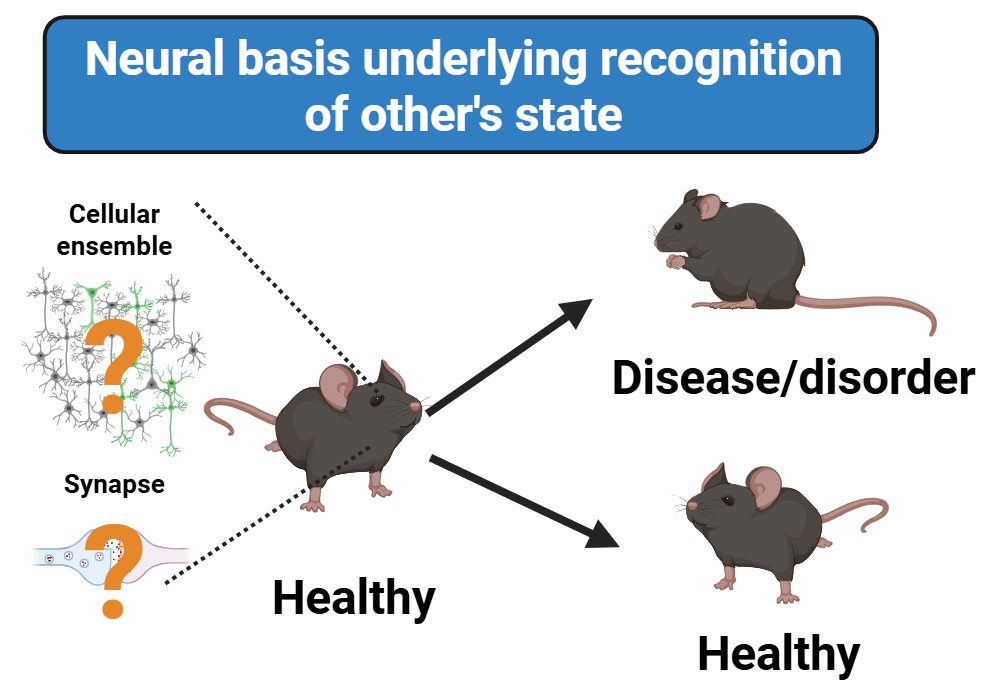
신경정신질환은 매우 높은 유병률을 보이며 다양한 생물학적 및 환경적 요인에 의해 발생합니다. 지금까지의 광범위한 연구를 통해 유전적, 분자적, 세포적, 그리고 신경회로 수준에서 중요한 기전들이 밝혀졌지만, 이러한 질환이 어떻게 발생하고 각 증상에 맞는 효과적인 치료 전략을 어떻게 개발할 수 있는지에 대한 이해는 여전히 불완전합니다. 특히 각 질환 내에서 나타나는 임상적 표현형의 다양성은 핵심적인 병태생리를 규명하는 데 큰 어려움을 초래하고 있습니다.
우리 연구실은 이러한 복잡성을 해소하기 위해, 서로 다른 환경과 맥락에서 유사한 증상을 보이는 다양한 신경정신질환이 기전적 수준에서 어떻게 구별될 수 있는지를 규명하고자 합니다. 이를 위해 여러 정신 및 신경계 질환에서 공통적으로 나타나는 생리학적 특징에 주목합니다. 많은 질환들이 일부 증상들을 공유하고 있다는 점에 착안하여, 특히 정서 및 인지 기능과 관련된 공통 증상의 시냅스 및 세포 수준의 기전을 이해하는 데 관심을 두고 있습니다. 이러한 연구 방향은 최근의 유전학적 연구에서 신경정신질환의 발병에 시냅스 및 세포 기능 이상이 중요한 역할을 한다는 사실이 강조되고 있다는 점에서도 동기를 얻고 있습니다. 또한 다양한 신경정신 및 신경학적 상태를 구별하는 신경학적 원리를 규명함으로써, 이들 질환이 공유하는 기전과 서로 다른 기전을 동시에 이해할 수 있는 개념적 틀을 제시하고자 합니다.
이러한 질환의 시냅스, 세포, 그리고 신경 집단 수준의 메커니즘을 밝히기 위해, 우리는 in vivo 칼슘 이미징, 광유전학(optogenetics), 화학유전학(chemogenetics), 그리고 머신러닝 기반 분석 등 최첨단 연구 기법을 활용합니다. 또한 신경정신질환의 병태생리를 새로운 관점에서 이해할 수 있도록 하는 혁신적인 방법론과 연구 도구를 개발하는 데에도 적극적으로 노력하고 있습니다. 궁극적으로 우리는 기초 신경과학적 기전 연구와 임상적 현상을 연결함으로써, 다양한 신경정신 및 신경학적 질환의 복합적인 증상을 보다 정밀하게 치료할 수 있는 표적화되고 개인 맞춤형 치료 전략의 개발에 기여하고자 합니다.
Neuropsychiatric disorders are highly prevalent and arise from diverse biological and environmental factors. Although extensive research has uncovered important mechanisms at the genetic, molecular, cellular, and circuit levels, our understanding remains incomplete, leaving major gaps in how these disorders develop and how effective therapeutic interventions can be tailored to specific symptoms. A central challenge is the diversity of clinical manifestations within each disorder, which obscures their core pathophysiology.
Our laboratory aims to disentangle this complexity by identifying how different neuropsychiatric disorders, which often present with overlapping symptoms in diverse contexts, can be differentiated at the mechanistic level. To achieve this, we focus on physiological commonalities across multiple psychiatric and neurological disorders, many of which share subsets of symptoms. In particular, we are interested in the synaptic and cellular bases of these shared symptoms relevant to emotional and cognitive function, motivated by recent genetic evidence highlighting the involvement of synaptic and cellular dysfunction in these conditions. Furthermore, we seek to clarify the neural principles that distinguish a variety of neuropsychiatric and neurological states, providing a framework for understanding both their shared and divergent mechanisms.
To uncover the synaptic, cellular, and population-level mechanisms underlying these disorders, we employ cutting-edge methodologies, including in vivo calcium imaging, optogenetics, chemogenetics, and machine-learning–based analyses. In addition, we are dedicated to developing novel methodologies and innovative tools that provide new perspectives on the pathophysiology of neuropsychiatric disorders. Ultimately, by bridging basic mechanistic insights with clinical phenomena, our goal is to pave the way toward targeted and personalized therapeutic strategies that address the diverse symptoms of neuropsychiatric and neurological disorders.
Major research field
분자 및 세포 신경과학; 생물학적 정신의학; 도구 개발 / Molecular and Cellular Neuroscience; Biological Psychiatry; Tool development
Desired field of research
생체공학; 기계 학습; 기계 학습 기반 분석 / Biomedical Engineering; Machine learning-based analysis
Research Keywords and Topics
시냅스; 신경생리학; 신경 활동; 행동; 생체 내 영상 촬영; 생물학적 정신의학; 도구 개발
Synapse; Neurophysiology; Neural activity; Behavior; In vivo imaging; Biological Psychiatry; Tool development
Research Publications
1. Son, S.*, Nagahama, K.*, Lee, J.*, Jung, K.*, et al. (Jan., 2024): Real-time visualization of structural dynamics of synapses in live cells in vivo. Nat. Methods 21(2): 353-360. PMID: 38191933 *: co-first authors
2. Hyun, J.H.*, Nagahama, K.*, et al. (Dec., 2022): Tagging active neurons by soma-targeted Cal-Light. Nat. Commun. 13(1): 7692. PMCID: PMC9744738 *co-first authors.
3. Nagahama, K., et al. (Sep., 2020): Setd1a insufficiency in mice attenuates excitatory synaptic function and recapitulates schizophrenia-related behavioral abnormalities. Cell Rep., 32(11):108126. PMID: 32937141
국가과학기술표준분류
- OA. 뇌과학

