

Faculty Research Profile
Jang Hyun Choi


학력
· 2001~2004: Ph.D. Department of Life Sciences, POSTECH, Korea
· 1999~2001: M.S. Department of Life Sciences, POSTECH, Korea
· 1995~1999: B.S. Department of Life Sciences, POSTECH, Korea
주요 경력
· 2024~present: Professor, Ulsan National Institute of Science and Technology
· 2016~2024: Associate Professor, Ulsan National Institute of Science and Technology
· 2012~2016: Assistant Professor, Ulsan National Institute of Science and Technology, School of Life Sciences, Korea
· 2007~2012: Post-Doctoral Fellow & Research Fellow, Department of Cell Biology, Dana-Farber Cancer Institute, Harvard Medical School, USA
· 2004~2007: Post-Doctoral Fellow, POSTECH Biotech Center, POSTECH, Korea
수상/학회/외부활동
· 2018: Rising-star Distinguished Professor at UNIST
· 2016: Rising Scientists for 21th Century (Dona-A Ilbo & POSTECH)
· 2012: PJ Park POSCO Chung-Am Fellowship
· 2012: Excellence Young Investigator Fellowship from NRF
· 2008: American Diabetes Association Fellowship
· 2006: Best Research Award from Korean Society of Cell Biology
· 2004: Best Paper Award from Korean Society for Molecular and Cellular Biology
· 2003: Best Research Award from Scientific Meeting of the Cell Biology
당뇨 및 대사질환 연구실
Lab. of Diabetes and Metabolism
우리 연구실은 지방 조직 생물학과 당뇨병 및 대사 질환과 같은 엄청난 병리학을 연결하는 분자 경로를 이해하는 데 관심이 있습니다. 이러한 연구는 새로운 항 당뇨병 치료제를 개발하기위한 과학적 기초가 될 수 있습니다. 다음은 우리의 주요 연구 주제입니다.
1. 지방 및 간 조직의 포도당과 지질 대사를 조절하는 분자 메커니즘
2. 대사성 암 발생 조절
3. 대사 질환 (당뇨병, 대사이상 지방간 질환 등) 치료제 개발
Our lab is interested in understanding the molecular pathways that link adipose tissue biology to this staggering array of pathologies such as diabetes and metabolic diseases. These studies can be the scientific basis for developing novel anti-diabetic agents. Followings are our main research topics:
1. Molecular mechanism of regulating systemic glucose and lipid metabolism in adipose tissue and liver
2. Regulation of metabolic-related cancer development
3. Development of novel therapeutics for metabolic diseases
Our lab is interested in understanding the molecular pathways that link adipose tissue biology to this staggering array of pathologies such as diabetes and metabolic diseases. These studies can be the scientific basis for developing novel anti-diabetic agents. Followings are our main research topics:
1. Molecular mechanism of regulating systemic glucose and lipid metabolism in adipose tissue and liver
2. Regulation of metabolic-related cancer development
3. Development of novel therapeutics for metabolic diseases
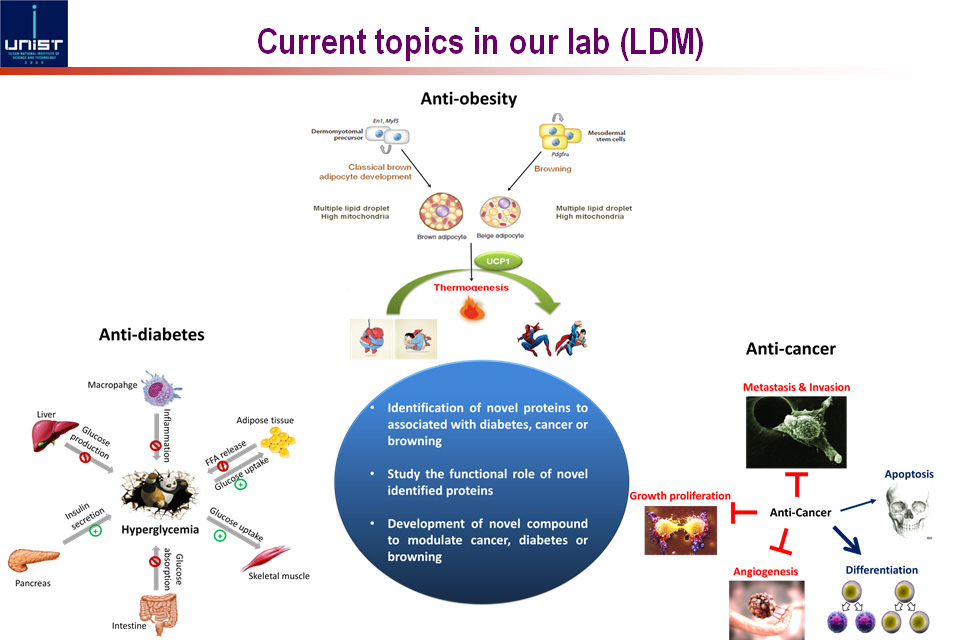
연구분야
비만, 당뇨병, 대사질환, 염증, 대사이상 지방간 질환 / Obesity, Diabetes, Metabolic Diseases, Inflammation, MASLD
Obesity, Diabetes, Metabolic Diseases, Inflammation, MASLD
연구주제
· 당/지질 대사 조절 핵심 기전 규명 및 새로운 대사질환 치료제 개발
· 백색지방의 갈색지방화를 활성화를 이용한 항비만 약물 개발
· 암 생성, 활성 조절 분자 기전 연구 및 새로운 혁신 항암제 개발
· Understanding of molecular mechanisms of regulating glucose/lipid metabolism & development of novel therapeutics for metabolic diseases
· Development of novel anti-obesity drugs via browning of white adipocytes
· Understanding the molecular mechanisms of cancer progression & development of novel anti-cancer drugs
· Understanding of molecular mechanisms of regulating glucose/lipid metabolism & development of novel therapeutics for metabolic diseases
· Development of novel anti-obesity drugs via browning of white adipocytes
· Understanding the molecular mechanisms of cancer progression & development of novel anti-cancer drugs
국가연구개발사업 기술 분류체계
국가과학기술표준분류
LA. 생명과학 > LA03. 발생·신경생물학 > LA0302. 내분비생물학
논문
· Metabolism; Lee Y.H. et al. (2025) miR-93 and MASLD
· eLife; Lee Y.H. et al., (2022) Hepatic MIR20B promotes nonalcoholic fatty liver disease by suppressing PPARA.
· Nucleic Acids Research; Ju et al., (2021) NSMF promotes the replication stress-induced DNA damage response for genome maintenance.
· Diabetes ; Choi, S. et al., (2016) PPARg antagonist Gleevec improves insulin sensitivity and promotes the browning of white adipose tissue.
· Genes and Development ; Choi, J. H., et al. (2014) Thrap3 docks on phosphoserine 273 of PPARg and controls diabetic gene programming.
· J. Biol. Chem.; Choi, S. S. (2014) A novel non-agonist PPARg ligand UHC1 blocks PPARγ phosphorylation by CDK5 and improves insulin sensitivity.
· Nature ; Choi, J. H., et. al. (2011) Potent Anti-Diabetic Actions of a Non-Agonist PPARg Ligand that Blocks Cdk5-Mediated Phosphorylation.
· Nature ; Choi, J. H., et. al. (2010) Anti-diabetic drugs inhibit obesity-linked phosphorylation of PPARg by cdk5.
특허
· Choi, J. H., Compositions, Kits, and Methods for Identification, Assessment, Prevention, and Therapy of Metabolic Disorders. PCT/US2011/021855
· Choi, J. H. Novel use of gleevec for treatment of diabetes mellitus and metabolic disease by specifically inhibiting phosphorylation at Ser273 of PPARg as PPARg agonist. 10-2014-0037199
· Choi, J. H. & Choi, S. Composition for degrading PPAR gamma comprising TRIM25 an active ingredient. 10-2072075