

Faculty Research Profile

Woongki Baek


학력
- 2011: Ph.D. in EE, Stanford University
- 2005: M.S. in EECS, Seoul National University
- 2003: B.S. in MSE and EE, Seoul National University
주요 경력
- 2022~Present: Professor, Department of Computer Science and Engineering, UNIST
- 2017~2022: Associate Professor, Department of Computer Science and Engineering, UNIST
- 2013~2017: Assistant Professor, Department of Computer Science and Engineering, UNIST, Ulsan, Republic of Korea
- 2012~2013: Senior Researcher, Electronics and Telecommunications Research Institute (ETRI), Daejeon, Republic of Korea
- 2011~2012: Platform Software Engineer, Microsoft Corporation, Redmond, WA, US
수상/학회/외부활동
- Most Influential PLDI Paper Award, 2020
- Program committee member for premier computer systems conferences including FAST'21, PACT'20, CCGrid'20, and DATE'20
- Best Paper Finalist at CCGrid, 2018
- Stanford Graduate Fellowship
- Samsung Scholarship (formerly known as the Samsung Lee Kun Hee Scholarship Foundation (SLSF))
지능형 시스템 소프트웨어 연구실
Intelligent System Software Lab
지능형 시스템 소프트웨어 연구실은 컴퓨터 시스템의 성능, 효율성, 보안성, 신뢰성을 획기적으로 향상시키는 혁신적인 시스템 소프트웨어 기법들에 대해서 연구한다. 본 연구실은 컴퓨터 아키텍처, 시스템 소프트웨어, 런타임 시스템, 응용에 걸친 시스템 전체 계층에 대한 수직적이고 통합적인 최적화 연구를 지향한다. 본 연구실은 현재 (1) 고성능, 효율형 기계학습을 위한 시스템 소프트웨어, (2) 기계학습 기반 시스템 소프트웨어 최적화, (3) 고확장, 고효율 병렬 및 분산 컴퓨팅, (4) 시스템 보안 등에 대한 연구를 활발히 수행하고 있다.
Intelligent System Software Lab (ISSL) investigates innovative system software techniques that significantly improve the performance, efficiency, security, and reliability of computer systems. ISSL takes a vertically integrated research approach to maximize the synergistic effects across the entire computer system hierarchy including computer architecture, system software, runtimes, and applications. Currently, ISSL focuses on the following research projects – (1) system software for high-performance and efficient machine learning, (2) machine learning-augmented system software, (3) scalable and efficient parallel and distributed computing, and (4) computer systems security.
Intelligent System Software Lab (ISSL) investigates innovative system software techniques that significantly improve the performance, efficiency, security, and reliability of computer systems. ISSL takes a vertically integrated research approach to maximize the synergistic effects across the entire computer system hierarchy including computer architecture, system software, runtimes, and applications. Currently, ISSL focuses on the following research projects – (1) system software for high-performance and efficient machine learning, (2) machine learning-augmented system software, (3) scalable and efficient parallel and distributed computing, and (4) computer systems security.
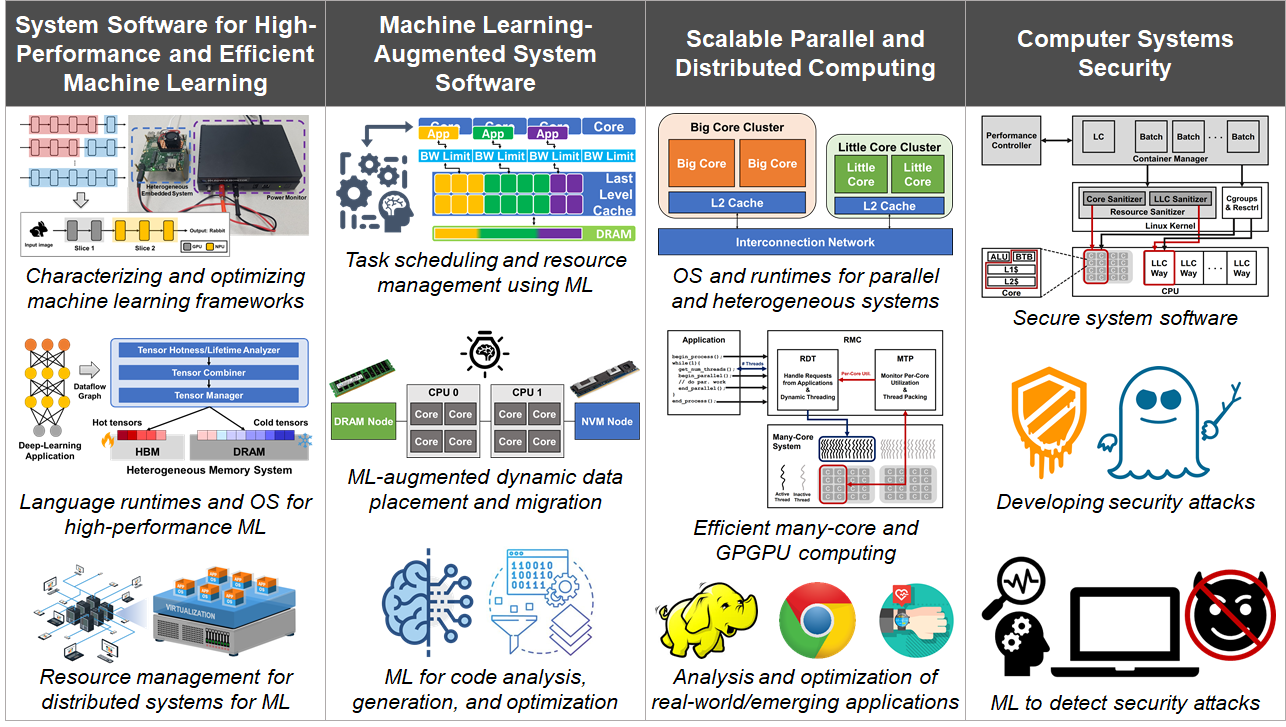
연구분야
System software for machine learning, ML-augmented system software, scalable parallel and distributed computing, computer systems security
System software for machine learning, ML-augmented system software, scalable parallel and distributed computing, computer systems security
연구주제
1. System Software for High-Performance and Efficient Machine Learning
- Characterizing and optimizing the machine-learning frameworks using high-performance accelerators
- Resource management for large-scale distributed systems for high-performance machine learning
2. Machine Learning-Augmented System Software
- Improving the efficiency of parallel and distributed task schedulers and resource managers using machine learning
- Machine learning-augmented dynamic data placement and migration techniques
3. Scalable and Efficient Parallel and Distributed Computing
- OS and runtime scheduling techniques for parallel and heterogeneous systems
- Performance/power analysis and optimization of real-world and emerging applications
4. Computer Systems Security
- Design and implementation of secure system software for safe and efficient computing
- Developing security attacks by exploiting the vulnerabilities of the system software and computer architecture
1. System Software for High-Performance and Efficient Machine Learning
- Characterizing and optimizing the machine-learning frameworks using high-performance accelerators
- Resource management for large-scale distributed systems for high-performance machine learning
2. Machine Learning-Augmented System Software
- Improving the efficiency of parallel and distributed task schedulers and resource managers using machine learning
- Machine learning-augmented dynamic data placement and migration techniques
국가연구개발사업 기술 분류체계
국가과학기술표준분류
EE. 정보/통신 > EE02. 소프트웨어 > EE0203. System Integration
논문
- Myeonggyun Han, Jihoon Hyun, Seongbeom Park, and Woongki Baek, “Hotness- and Lifetime-Aware Data Placement and Migration for High-Performance Deep Learning on Heterogeneous Memory Systems,” in the IEEE Transactions on Computers (TC), 2020.
- Myeonggyun Han, Jihoon Hyun, Seongbeom Park, Jinsu Park, and Woongki Baek, “MOSAIC: Heterogeneity-, Communication-, and Constraint-Aware Model Slicing and Execution for Accurate and Efficient Inference,” in the Proceedings of the 28th International Conference on Parallel Architectures and Compilation Techniques (PACT), Sep. 2019.
- Jinsu Park, Seongbeom Park, and Woongki Baek, “CoPart: Coordinated Partitioning of Last-Level Cache and Memory Bandwidth for Fairness-Aware Workload Consolidation on Commodity Servers,” in the Proceedings of the 14th European Conference on Computer Systems (EuroSys), Mar. 2019.
특허
- Lightweight architecture for aliased memory operations, Woongki Baek and Seung Hoe Kim, US Patent 10,223,261, 2019
- Reliability-aware application scheduling, Woongki Baek et al., US Patent 9,436,517, 2016