

Faculty Research Profile
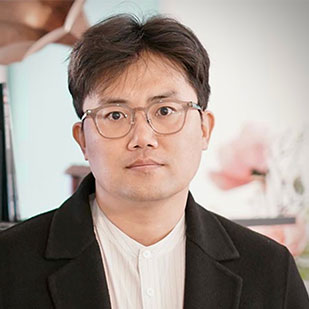
Sung You Hong


학력
2005–2009 University of Oxford;
Doctor of Philosophy (DPhil)
Department of Chemistry
----------------------
1998–2002 Seoul National University;
Bachelor of Science
School of Chemical and Biological Engineering
주요 경력
2010-Present UNIST
Professor (2022-present)
Associate Professor (2015-2022)
Assistant Professor (2010-2015)
----------------------
2009–2010 Max Planck Institute of Colloids and Interfaces, Potsdam, Germany; Department of Biomolecular Systems; Postdoctoral Scholar
수상/학회/외부활동
March 2020 Outstanding Faculty Award, UNIST
----------------------
2005–2009 Samsung Lee Kun Hee Scholarship for the Doctoral Studies at University of Oxford
유기합성연구실
Synthetic Organic Chemistry
The major research themes in our laboratory are to develop metal-catalyzed synthetic routes to afford functionalized small molecules. Issues of regiochemistry, oxidation state changes of transition metal complexes, and efficiency to construct carbon–carbon and carbon–heteroatoms have been the central topics of our synthetic approaches.
The major research themes in our laboratory are to develop metal-catalyzed synthetic routes to afford functionalized small molecules. Issues of regiochemistry, oxidation state changes of transition metal complexes, and efficiency to construct carbon–carbon and carbon–heteroatoms have been the central topics of our synthetic approaches.
연구분야
유기합성, 레독스 반응, 전이금속 촉매 반응 / organic chemistry, redox chemistry, metal-catalyzed organic synthesis
organic chemistry, redox chemistry, metal-catalyzed organic synthesis
연구주제
The SYH group’s research centers on selective bond activation and functionalization for molecular complexity. Our research themes include (i) metal-catalyzed selective transformations and/or functionalizations of π-system, (ii) directed or nondirected C−H arylation of (hetero)arenes using hypervalent compounds, and (iii) oxidation-state modulation to access active radical species or to activate inert bonds.
The SYH group’s research centers on selective bond activation and functionalization for molecular complexity. Our research themes include (i) metal-catalyzed selective transformations and/or functionalizations of π-system, (ii) directed or nondirected C−H arylation of (hetero)arenes using hypervalent compounds, and (iii) oxidation-state modulation to access active radical species or to activate inert bonds.
국가연구개발사업 기술 분류체계
국가과학기술표준분류
NC. 화학 > NC02. 유기화학 > NC0203. 유기합성방법론
논문
- Nat. Commun. 2022, 13, 2421. "Rapid access to polycyclic N-heteroarenes from unactivated, simple azines via a base-promoted Minisci-type annulation" Lee, J. B.; Kim, G. H.; Jeon, J. H.; Jeong, S. Y.; Lee, S.; Park, J.; Lee, D.; Kwon, Y.; Seo, J. K.; Chun, J.-H.; Kang, S. J.; Choe, W.; Rohde, J.-U.*; Hong, S. Y.*
- J. Am. Chem. Soc. 2017, 139, 12121–12124. “Nickel-catalyzed azide–alkyne cycloaddition to access 1,5-disubstituted 1,2,3-triazoles in air and water” Kim, W. G.; Kang, M. E.; Lee, J. B.; Jeon, M. H.; Lee, S.; Lee, J.; Choi, B.; Cal, P. M. S. D.; Kang, S.; Kee, J.-M.; Bernardes, G. J. L.; Rohde, J.-U.; Choe, W.; Hong, S. Y.*
- Angew. Chem., Int. Ed. 2017, 56, 5007–5011. “An annulative synthetic strategy for building triphenylene frameworks via multiple C–H activations” Mathew, B. P. ‡; Yang, H. J.‡; Kim, J.; Lee, J. B.; Kim, Y.-T.; Lee, S.; Lee, C. Y.; Choe, W.; Myung, K.; Park, J.-U.*; Hong, S. Y.**