

Faculty Research Profile
Chun Sang Yoo


학력
· 2005: Ph.D. in Mechanical Engineering, University of Michigan, Ann Arbor, MI, USA
· 1998: M.S. in Mechanical Engineering, Seoul National University, Korea
· 1996: B.S. in Mechanical Engineering, Seoul National University, Korea
주요 경력
· 2009 - Present: Assistant/Associate/Full Professor, UNIST, Korea
· 2020 - Present: Director, UNIST Supercomputing Center
· 2006 - 2009: Post-doctoral Research Fellow, Combustion Research Facility, Sandia National Laboratories, CA, USA
· 1998 - 2001: Lecturer, Department of Mechanical Engineering, Republic of Korea Naval Academy, Korea
수상/학회/외부활동
- Journal Editor/Editorial Board
· Journal of Mechanical Science and Techonology, Associate editor (2019~Present)
· Journal of The Korean Society of Combustion, Associate editor (2020~2022)
· Energies, Editorial Board (2020~Present)
- Awards & Honors
· The Best Research Award, The Korean Society of Combustion (KOSCO), Nov.2016
· The Young Investigator Award, Asia- Pacific Conference on Combustion, Jul.2015
친환경 연소 및 에너지 연구실
Clean Combustion & Energy Research Lab
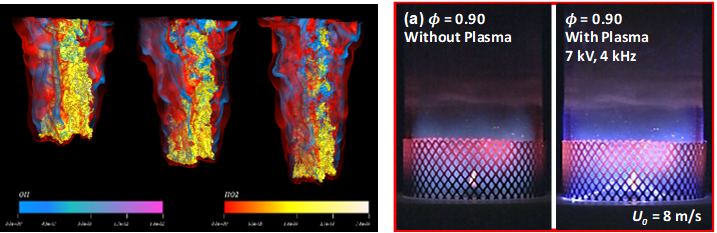
친환경 연소 및 에너지 연구실에서는 무탄소/고효율 연소기 및 가스터빈(GT)엔진 개발을 위해 수소/암모니아/초임계/플라즈마에 주목하고 있습니다. 수소 및 암모니아는 탄소를 포함하고 있지 않아 CO2 발생이 없는 청정 연료로 기존 GT 연소기에 적용하는 무탄소 연소 연구가 이루어지고 있습니다. 최근, 기존의 GT 연소 방식이 아닌 초임계 GT 연소 방식이 새롭게 대두되었고 이에 본 연구실에서는 250 bar 이상의 초임계 상태의 연소 특성을 연구하고 있습니다. 이와 같은 연소 방식들은 NOx 저감을 위해 희박 연소 영역에서 작동이 이루어지고 있고 이때 발생할 수 있는 연소 불안정성을 제어하기 위한 플라즈마 적용 연소 방식 또한 활발히 연구하고 있습니다. 이와 더불어 암모니아 분해를 통한 수소 생산을 위해 surface chemistry를 적용한 CFD 코드 개발 및 해석을 수행 중에 있습니다.
In Clean Combustion and Energy Research Lab, we are focusing on the development of zero-carbon/high-efficiency combustion systems and gas turbine (GT) engines. Our attention is directed towards hydrogen/ammonia/supercritical/ plasma for this purpose. Hydrogen and ammonia are clean fuels that do not contain carbon, resulting in no CO2 emissions when applied to conventional GT combustors. Recently, a novel approach involving supercritical GT combustion has emerged as an alternative to conventional GT combustion, and our lab is actively studying combustion characteristics at conditions exceeding 250 bars. These combustions operate in fuel-lean conditions to reduce NOx emissions, and we are actively researching plasma-assisted combustion techniques to control combustion instability that may occur during such fuel-lean combustion conditions. Additionally, we are conducting research on the application of surface chemistry for ammonia cracking to produce hydrogen, and we are developing and analyzing CFD codes for this purpose.
In Clean Combustion & Energy Research lab, we are investigating the characteristics of laminar/turbulent reacting flows using direct numerical simulations (DNS), large eddy simulations (LES), and Reynolds-Averaged Navier-Stokes Simulations (RANS) to understand flame instability, turbulence/chemistry interaction, etc. An indepth understanding of fundamental characteristics of laminar/turbulent flames can help us develop next-generation IC engines, gas turbines (GT), and commercial boilers. We are also interested in hydrogen/ammonia/supercritical/plasma combustion to develop low carbon/high-efficient IC engines and GT combustors. Hydrogen and ammonia are carbon-free energy source such that they are now being applied to conventional GT combustors. Recently, a supercritical GT combustion emerges as a next-generation technology for power generation, and hence, we are investigating the characteristics of supercritical combustion at 250 bar or above. To reduce NOx emission, fuel-lean combustion is inevitable, which ultimately induces flame instabilities in the combustor. To control such flame instabilities, plasma-assisted combustion is also actively investigated. In addition, we are developing a CFD code for hydrogen production through ammonia cracking considering both gas-phase chemistry and surface chemistry.
연구분야
DNS/LES/RANS, 가스터빈 연소, 플라즈마 응용 연소, 초임계 CO2 순산소 연소, 암모니아 크랙킹 및 연소
DNS/LES/RANS, Gas Turbine Combustion, Plasma-assisted Combustion, sCO2 Oxy-fuel Combustion, Ammonia Cracking & Combustion
연구주제
난류 연소, 직접 수치 시뮬레이션, 엔진 연소, 가스 터빈 연소, 플라즈마 보조 연소, sCO2 순산소 연소, 암모니아 리포밍/크랙킹 및 연소
Turbulent Combustion, Direct Numerical Simulation, Engine Combustion, Gas Turbine Combustion, Plasma-assisted Combustion, sCO2 Oxy-fuel Combustion, Ammonia Reforming/Cracking & Combustion
Turbulent Combustion, Direct Numerical Simulation, Engine Combustion, Gas Turbine Combustion, Plasma-assisted Combustion, sCO2 Oxy-fuel Combustion, Ammonia Reforming/Cracking & Combustion
국가연구개발사업 기술 분류체계
국가과학기술표준분류
EA. 기계 > EA09. 자동차·철도차량 > EA0901. 엔진/동력전달장치
논문
· Computer Physics and Communication 273, 108264, "Real-fluid thermophysicalModels library: An OpenFOAM-based library for reacting flow simulations at high pressure", Nguyen, D.N., Jung, K.S., Shim, J.W., Yoo, C.S., 2022,
· Combustion and Flame 233, 111584, "On the stabilization mechanisms of turbulent lifted hydrogen jet flames in heated coflows near the auto-ignition limit: A comparative DNS study", Jung, K.S., Kim, S.O., Lu, T., Chen, J.H., Yoo, C.S., 2021
· Combustion and Flame, 212, 403-414, "Effects of non-thermal plasma on the lean blowout limits and CO/NOx emissions in swirl-stabilized turbulent lean-premixed flames of methane/air", Kim, G.T., Yoo, C.S., Chung, S.H., J., 2020.
특허
· [국내] 예혼합 압축 착화 엔진의 연소 제어 방법, 유춘상, (2012.03)