

Faculty Research Profile
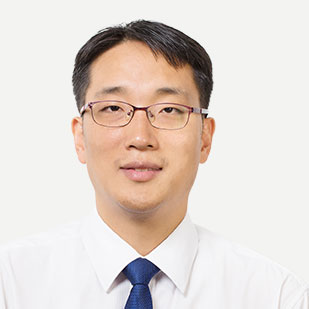
JunHee Lee


학력
• 2008: Doctor of philosophy, Theoretical Condensed-Matter Physics, Department of Physics, Seoul National University
• 2003: Master of Science, Physics, Seoul National University
• 2001: Bachelor of Science, Physics, Seoul National University
주요 경력
• 2023 - Present: Full Professor, UNIST
• 2019 - 2023: Associate Professor, UNIST
• 2015 - 2019: Assistant Professor, UNIST
• 2013 - 2015: Post-doctoral Fellow, Oak Ridge National Lab, USA
• 2011 - 2013: Post-doctoral Fellow, Princeton University, USA
• 2010: Visiting Scholar, University of California, USA
• 2008 - 2011: Post-doctoral Fellow, Rutgers University
• 2006 - 2007: Researcher, Jawaharlal Nehru Centre for Advanced Scientific Research, India
수상/학회/외부활동
• Commendation from the Minister of Merit (소재 부분 유공장관 표창) 2020)
• Organizers for Korean Physics Society(KPS), Korean Ceramic Society, and Korean Ferroelectric Society
• Member in Materials Research Society(MRS), American Physics Society(APS)
에너지변환 양자물질 연구실
Quantum Materials for Energy Conversion Lab
Our lab(QMEC) uses supercomputers and artificial intelligence (AI) to find new materials that could not been found manually and then synthesize them through experiments. We design new materials, representatively, in three fields (memory semiconductors, hydrogen generation catalysts, and electric vehicle motor magnets).
1. DRAM and NAND-Flash via HfO2 & ZrO2 ALD
It becomes difficult to keep the ‘super gap’ in the memory industry, due to a scaling limitation of nanotechnology. We created a new paradigm to override the limitation based on our discoveries of “Atomic Semiconductors” that store information directly in atoms of solids. Conventional ferroelectrics store only 1 bit of information over a domain of thousands of atoms or more. How-ever, our group, by applying flat band theory to memory materials, proved that one bit can be stored in an individual atom in HfO2 solid for the first time in the world, as reported in SCIENCE (H.-J.Lee et al., Science 369, 1343(2020)). We are currently conducting experiments to reach up to a memory density of 10TB, which is more than 100 times higher than the commercialized memory densities.
2. New H2 Catalysts from AI (Artificial Intelligence)
Hydrogen and oxygen are generated at the same time from water decomposed, but the oxygen evolution reaction(OER) is still slow and requires a lot of precious metals such as IrO2 and RuO2 etc. Our group is developing various oxide catalysts that are low-priced and can significantly improve OER by supercomputer simulations and machine learning. We use a supercomputer to predict catalytic performance, using more than 4 different inexpensive metal dopants with the help of AI to predict the performance of all metal combinations in the periodic table. We conduct experimental research selectively with a good combination of catalysts found on this basis, which allow us to discover the next generation catalysts quickly and efficiently. This method, in the future, will provide a template for studying catalysts in all the other fields, as we plan to expand our research area to various photo- and electro-catalysts
such as CO2 conversion and so on.
3. Super Magnets for Motors in Electric Vehicles
Power-based cars(electric cars and hydrogen cars) use motors instead of conventional combustion engines. Therefore, the performance of the magnets in the motors is paramount. These magnets must retain their magnetism well in terms of its strength and stability even at high temperatures where cars work. Currently, rare earth metals such as neodymium magnet (Nd2Fe14B) have been used a lot, but it’s hard to overcome the price issue. Using AI+supercomputer, we are searching for cheap yet strong magnets utilized for motors in electric vehicles.
Our lab(QMEC) uses supercomputers and artificial intelligence (AI) to find new materials that could not been found manually and then synthesize them through experiments. We design new materials, representatively, in three fields (memory semiconductors, hydrogen generation catalysts, and electric vehicle motor magnets).
1. DRAM and NAND-Flash via HfO2 & ZrO2 ALD
- It becomes difficult to keep the ‘super gap’ in the memory industry, due to a scaling limitation of nanotechnology. We created a new paradigm to override the limitation based on our discoveries of “Atomic Semiconductors” that store information directly in atoms of solids. Conventional ferroelectrics store only 1 bit of information over a domain of thousands of atoms or more. How-ever, our group, by applying flat band theory to memory materials, proved that one bit can be stored in an individual atom in HfO2 solid for the first time in the world, as reported in SCIENCE (H.-J.Lee et al., Science 369, 1343(2020)). We are currently conducting experiments to reach up to a memory density of 10TB, which is more than 100 times higher than the commercialized memory densities.
2. New H2 Catalysts from AI (Artificial Intelligence)
- Hydrogen and oxygen are generated at the same time from water decomposed, but the oxygen evolution reaction(OER) is still slow and requires a lot of precious metals such as IrO2 and RuO2 etc. Our group is developing various oxide catalysts that are low-priced and can significantly improve OER by supercomputer simulations and machine learning. We use a supercomputer to predict catalytic performance, using more than 4 different inexpensive metal dopants with the help of AI to predict the performance of all metal combinations in the periodic table. We conduct experimental research selectively with a good combination of catalysts found on this basis, which allow us to discover the next generation catalysts quickly and efficiently. This method, in the future, will provide a template for studying catalysts in all the other fields, as we plan to expand our research area to various photo- and electro-catalysts
such as CO2 conversion and so on.
3. Super Magnets for Motors in Electric Vehicles
- Power-based cars(electric cars and hydrogen cars) use motors instead of conventional combustion engines. Therefore, the performance of the magnets in the motors is paramount. These magnets must retain their magnetism well in terms of its strength and stability even at high temperatures where cars work. Currently, rare earth metals such as neodymium magnet (Nd2Fe14B) have been used a lot, but it’s hard to overcome the price issue. Using AI+supercomputer, we are searching for cheap yet strong magnets utilized for motors in electric vehicles.
연구분야
전산모사, 기계학습, 메모리 반도체, 강유전체, 전기화학 촉매, 전기-수소차 모터용 자석
연구주제
• Materials / Catalytic materials, Ferroelectrics, Magnetic materials
• Physics / Ferroelectricity, Magnetism, Topology
• Computational Science / Density Functional Theory (DFT), Molecular Dynamics, Machine Learning, AI
• Materials / Catalytic materials, Ferroelectrics, Magnetic materials
• Physics / Ferroelectricity, Magnetism, Topology
• Computational Science / Density Functional Theory (DFT), Molecular Dynamics, Machine Learning, AI
국가연구개발사업 기술 분류체계
국가과학기술표준분류
NB. 물리학 > NB06. 응집물질물리 > NB0602. 응집물질 계산과학
논문
• SCIENCE / “Scale-free ferroelectricity induced by flat phonon bands in HfO2” / Hyun-Jae Lee, Minseong Lee, Kyoungjun Lee, Jinhyeong Jo, Hyemi Yang, Yungyeom Kim, Seung Chul Chae, Umesh Waghmare, Jun Hee Lee* / 2020-07
• Physical Review Letters / “Giant Spin-Driven Ferroelectric Polarization in BiFeO3 at Room Temperature” / Jun Hee Lee*, Randy Fishman / 2015-11
특허
• 유전 박막, 및 이를 포함하는 멤커패시터 / 이준희, 박노정 / 2019-11
• 2차원 강유전성 물질을 이용한 비휘발성 3진 메모리 소자 및 이의 제조 방법 / 이준희, 이호식 / 2019-11